
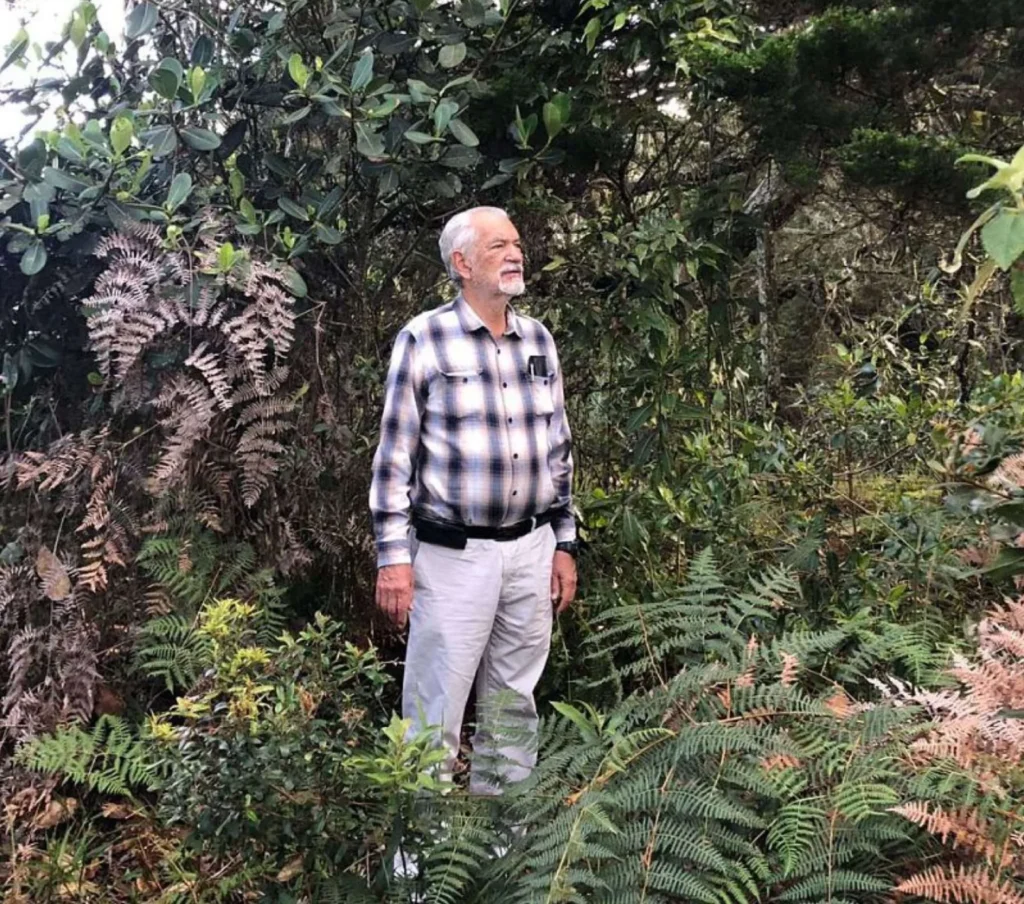
Thirty-five years ago on the mountain ridge, facing the cows and the fields planted with potatoes. In the very same spot where, on clear days, one can see with the naked eye the valley of San Nicolás de Rionegro, La Piedra de el Peñol, and the Farallones del Citará, Carlos Pineda, an orthopedic surgeon, asked Luis Gonzalo Soto Atehortúa, a farmer from the region of Santa Elena: “Hey, Luis Gonzalo, would it be very difficult to get trees to grow on this land?”
 Luis Gonzalo, a nature lover, replied, “No, it’s no problem…” From that day on, the doctor and the farmer teamed up with the sole goal of restoring the native forest to the mountain.
“Luis Gonzalo taught me the natural way for the forest to grow,” says Carlos. “First the ferns come in, then they cover the grass. The grass dries up, and beneath the ferns, small animals and birds leave twigs, berries, and bits of the neighboring forest… That’s how, with nature’s help and a little patience, the forest is born. Back then, there was less than half a block of forest; today, it can stretch over fifteen blocks.”
Carlos Pineda has a deep connection to the mountains. “When I first came to the mountains, I said to myself, ‘How wonderful—a mountain to care for, just as one cares for the woman one finds in life!’ I fell in love with it, and here I am…” Caring for the mountains has been a matter of patience and conviction.
There was no shortage of forestry engineers who advised him to plant pátula pines, which, on that ridge, would yield an excellent return in just a few years. Nor was there any shortage of those who thought the land was perfect for subdivision. And for the past thirty years, people have been climbing up to the ridge to take in the view.
However, Carlos didn’t take any of the above advice to heart. “If people come all the way out here to enjoy the scenery, let’s build a lookout point—a place where people can come, rest, take in the fresh air, and admire the beauty of Antioquia.”
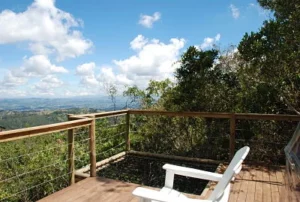 El Mirador has been around for over twenty-five years. Visitors will find a splendid landscape, a natural forest, a restaurant where you can grab a bite to eat or a drink, a peaceful place to spend a few nights in cabins or glamping tents, and above all, a space to disconnect from the city while sharing unique moments with family, friends, or a partner, surrounded by the tranquility of nature and connecting with the earth through all five senses.
Over the course of forty years living in the mountains, Carlos Pineda, guided by Luis Gonzalo, learned to understand them. Now he can identify tree species just by looking at them: “They looked so beautiful, and I didn’t even know they existed.”
What happened to me with them is what happens to someone who has a neighbor they’ve never met—they don’t know that he’s charming or that he’s the one who’s brought the land to life—and then you discover him overnight… And how could you not love that neighbor! All these trees were my neighbors, and I didn’t know them… “Now I know them and can name them without fear of being wrong: this is a myrtle; that one, the seven-leaves; over there is the cinnamon tree; the chiriguaco and the encenillo.”
My mom used boiled encenillo leaves to make hair gel and style our hair; and from that other one, the Drago, they extract a sap that’s used to heal wounds… “And so, as when speaking of something he knows well, Carlos Pineda mentions the Amarrabollos, the Carate, the Niguito, the Chilca, the ferns, and the king of ferns: the tree fern. Also, the Tabaquillo and the Cajeto.”
“The wildlife is very scarce,” says Carlos, “and the reason is that climate change has affected flowering: the trees aren’t producing fruit, and that’s having an impact on the wildlife. We’ve let too much time go by, and it’s getting harder and harder to restore the land. Very few birds come here anymore, and there aren’t any butterflies either. In the pits we’ve dug to collect rainwater, there are no longer any tadpoles, and only occasionally do we see a few Lesser Spotted Eagles.”
There is no undergrowth in the mountains. Undergrowth is the result of neglect. The forest’s greatest enemy is people: moss; thistles that grow on trees; and the soil that is stripped away. Deforestation is another human-caused problem, where the forest is mistreated, leading to landslides, waterlogging, and the destruction of everything in its path—including homes.
“I learned to love this forest and the farmers in this region by watching how they care for it, because they understand its importance. However, when the aqueduct was built, people weren’t educated about it, and since everyone can now have water regardless of whether they take care of the forest or not, some have lost interest in it. I don’t know how projects are carried out in these places without educating people about their relationship with the forest…”
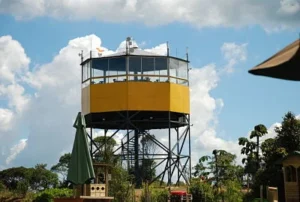 “We built a tower on the edge of the mountain,” says Carlos Pineda. “It’s a twelve-meter-tall octagon designed to draw attention to the land. From here, the Antioquia Gaia Tower, it will be possible to take in the surrounding area.”
“Gaia” is the Mother of all things, the origin of the earth and the universe in Greek mythology. It is our way of raising awareness about the state of the planet. A tower visible from the highway, various locations in the east, and from airplanes.
To reach the Cerro Verde Lookout and fall in love with the mountain and the land, simply take the Las Palmas Avenue bypass. There’s an entrance across from the D1; the lookout is five and a half kilometers away. Just follow the signs, and there, on the ridge, stands the Mountain—with a capital M…
Welcome to Mirador Cerro Verde… Your home, my home, and our home.